The following information was provided
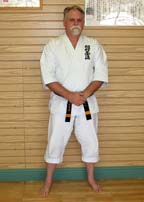
by Mr. Dave Burt, retired head instructor of Texas Kobukan:
What
is now the Texas Kobukan began back in 1984 as the Way of the Peaceful Warrior School, when Dave Burt left the AKBBA (American Karate
Black Belt Association) to continue training with his Instructor, Bob Click, at
a local dance studio in Duncanville, Texas. Soon after his leaving the Association, Mr. Click
retired altogether from Tae Kwon Do. Only a Brown Belt at the time, Mr. Burt
inherited his two eight year old students. Slowly, the school grew
with as many as 15 students attending regularly.
 It
was at the former school that Mr. Burt met a guest instructor, Mr. Godsil. Teaching there only a few times, Mr. Burt was
impressed with Mr. Godsil’s teaching, knowledge and
ability. Mr. Godsil’s top student was Troy Amason. Before long, the three had struck up a close
friendship and began training almost every day together. Mr. Godsil was a Black Belt in Tae Kwon Do, but he was
currently training in Shuri Ryu,
an Okinawan system under the direction of Master
Robert Trias.
It
was at the former school that Mr. Burt met a guest instructor, Mr. Godsil. Teaching there only a few times, Mr. Burt was
impressed with Mr. Godsil’s teaching, knowledge and
ability. Mr. Godsil’s top student was Troy Amason. Before long, the three had struck up a close
friendship and began training almost every day together. Mr. Godsil was a Black Belt in Tae Kwon Do, but he was
currently training in Shuri Ryu,
an Okinawan system under the direction of Master
Robert Trias.
For
two years Mr.Burt trained on his own in Tae Kwon Do
when Mr. Godsil moved back to his hometown in Gailsburg, IL. Mr. Godsil arranged for
Mr. Burt to have his Kata reviewed in Texas by 7th Degree Master, Tim Tieyah,
the teacher of Allen Stein, the founder of the Texas Karate schools. Mr. Tieyah approved his kata and gave
permission for Mr. Burt to test for his Black Belt. For the past two years, Mr. Burt had honed
his fighting skills by inviting himself to area martial art schools and
fighting all takers. By combining the principles of Tae Kwon Do and Shuri Ryu, Mr. Burt more often
than not, turned out to be the superior fighter, defeating 4th Degree Black
Belts and tournament champions. When Mr. Burt felt he was ready, he flew to Illinois and on the 16th day of July, 1986, received his
Black Belt certificate, sanctioned by Tim Tieyah, the
director of the Southwest Karate Black Belt Association. Upon his return, Mr. Tieyah presented Mr. Burt not only with his patch, but also
an Instructor’s patch, one of only five, (at the time) Mr. Tieayh
had ever handed out. This was a great honor for Mr. Burt, but his heart now
belonged to Okinawa. In the meantime, Mr. Godsil
and Mr. Amason had left Shuri
Ryu in favor of another Okinawan
system, Matsumura Kenpo. Mr. Burt soon followed and
both Texas schools were soon training together in the same
system, for the first time. Sometimes Mr. Amason’s
School would train at the dance studio and sometimes Mr. Burt’s students went
to the elementary school gym down the road. This continued for a few years
until the rent got too high at the dance studio. Mr. Amason
invited Mr. Burt’s school to permanently train with them. Though under one
roof, the two schools retained separate instruction, for the most part, with
Instructors switching off in their areas of expertise. This worked very well
for several years. It was during this time, that Mr. Burt accredits much of his
learning Matsumura Kata to Mr. Amason.
In 1988, both attained their Shodan, signed by Master
Yuichi Kuda. Mr. Burt then named his school the
Matsumura Budo-Kai. Upon receiving his Directorship
in 2001, the school’s name was again changed to the Texas Kobukan.
Due
to an unforeseen neck injury, Mr. Amason was forced
to retire from Karate. Mr. Burt was a 3rd Degree Black in Matsumura Kenpo when Mr. Amason’s top student
inherited his school. Unfortunately, the new arrangement did not go as smoothly
and Mr. Burt was forced to remove his school and students to a new
location. The school met at a local
church for several months, and then moved to its current location in DeSoto, Texas where the Texas Kobukan remains today.
After
eighteen grateful years, Mr. Burt retired from the Okinawan
Shorin Ryu Matsumura Karate and Kobudo
Association in 2004 as a 6th Degree Black Belt, Regional Director,
having attained the honor of Renshi and his Kyoshi license. He is honored to have as his former
students Mr. Bob Finley and Mr. Jecku Jacob, the
instructors of the Texas Kobukan. They superbly exemplify Karatedo.